Tuesday, May 21, 2024

Tuesday, December 5, 2023

Friday, September 1, 2023
Thursday, August 10, 2023
Yamaha OEM Water Pump Solution
For all my friends that are flying with a Yamaha engine that are concerned with OEM water pump failures. I messaged Steve Henry, pilot of the "Hee Haw" STOL airplane. He is using the 3 cyl. Yamaha. My friend Kurt Carlsen spoke with him at Air Venture. Steve is using two electric water pumps in line, one for back up one as the primary. He has taken the impeller of the shaft of the OEM pump and simply put it back together.

Tuesday, June 27, 2023
Flight Following
Last week I was talking with my CFI friend Jon Carlton about ADSB in and out on experimental aircraft. The discussion included the use of flight following for VFR flights in the USA. It is a free service to all pilots with a transponder.
None of my previous experimental aircraft have had a transponder and flight following was not something I had previously considered. My new Aviomania Duo will have a transponder and ADSB in and out. For future long cross country flights, I will use flight following.
Here is an excellent article on the topic:
Wednesday, May 10, 2023
Why I decided on flying an Aviomania Duo and representing the brand!
Here is a picture of me helping my friend Bobby Ward get buckled in to take his first gyroplane ride.

Before I built the Tangogyro, I had considered building an Aviomania G2sB Genesis Duo and after Bobby finished his machine I saw an opportunity as I retire this month to become the Aviomania Aircraft North American Agent since no one was helping promote their gyroplanes here.
The first step required selling my Tangogryo and once that happened, I contacted Nikolas Karolides at Aviomania and ordered my first kit. Now I have established Aviomania of Texas, LLC. My plan is to have several quick ship and build rolling airframe kits stored in my hangar in Texas. This will make it quicker for North American customers to purchase and get started building without a delay from Cyprus. Once a sale is made, the customers engine, instruments rotor blades and propeller will be ordered and be ready once the airframe is built.
I will also provide service, parts and a builder assist program. Here is my new digital business card.
Tuesday, May 9, 2023
Phase 1 Changes IAW AC 90-89C
Phase I can be a task-based flight test plan. The criteria is located on the attached pdf.
2.1.6.2 Expectations. The ability to use the task-based flight test plan as provided in this AC is enabled via the issuance of an operating limitation that allows its use, in lieu of the minimum 25- or 40-hour flight test periods contained in previously issued operating limitations. The FAA will permit the use of a task-based flight test plan based on your use of this AC and adherence to the objectives of the task-based flight test plan, providing the specified logbook entry, and maintaining the AOH on board the aircraft following flight testing. No formal FAA acceptance process is necessary for the builder to utilize a task-based flight test plan. Issuance of operating limitations with the traditional minimum hourly flight test periods specified for a pilot to flight test their aircraft as the sole occupant of the aircraft during Phase I remains for those who choose to do so in accordance with those operating limitations. There is no requirement to create, submit, or use a formal flight test plan. However, the FAA strongly encourages amateur builders to develop and utilize an individualized, comprehensive, requirements-based, operation centric (task-based) flight test plan appropriate for the complexity of the aircraft with specific tasks and objectives. The FAA also encourages builders to utilize the Additional Pilot Program (APP) described in AC 90-116, Additional Pilot Program for Phase I Flight Test. A task-based flight test plan should contain the minimum elements described in this AC, provide aircraft systems reliability and flight envelope testing to ensure that the aircraft is controllable throughout its normal range of speeds and throughout all the maneuvers to be executed, and ensure that the aircraft has no hazardous operating characteristics or design features. The FAA expects that builders follow their flight test plan, including those who utilize a task-based flight test plan. AC 90-89C
Tuesday, March 28, 2023
Transition


We recently completed our new home and hangar in an aviation community east of Dallas, Texas. I have finally decided to retire from being a school teacher at the end of May.
For many years, even before I owned a Tangogyro, I was interested in building, flying and selling Aviomania Gyroplanes.
I sold my Tangogyro the week before Bensen Days and ordered my new G2sB Genesis Duo.
From https://aviomania.com/g2sb-genesis-duo/
"This gyroplane was designed in 2007. Like all our aircraft it has been tested extensively for safety, stability, maneuverability and performance. A lot of hours have been accumulated proving it to be a superb and forgiving trainer. It incorporates ALL the latest understanding in Gyroplane Aerodynamics and Stability.The airframe, as all of our aircraft was carefully designed for the best possible PILOT PROTECTION by a light, but very strong triangulated airframe that positions the Kevlar reinforced fuel tank in a protected airframe area. Same key features as our single seat gyroplanes which include true CLT design, a specially designed tail that compensates for most of the engine’s torque, preventing torque over, bunt over, power push over, PIO as much as possible and keep the airframe always parallel with the rotor’s flight path. This offers exceptional stability in all aspects of flight.All materials and hardware used in the construction of “Genesis” are Aircraft Grade. (6061 T6, 7075 T6, 4130 Alloy, AN Hardware). We strongly believe that, we are offering the best gyroplane that combines excellent safety, stability, performance and maneuverability. The gyroplane is offered with either a small nose pod (same style as the single seat), or with the new full body length open cabin."
It will come with the Rotax 912ULS at 100 HP and I may eventually upgrade to the Edge Performance EP912STI and 154 HP. Once it is complete I plan to purchase additional kits needed to officially become the Aviomania North American Distributor.
Tuesday, March 1, 2022
Low Rider
Last year I found an old air command low boy gyroplane kit that I am converting to a center line thrust machine. It will have a 3 Cylinder Yamaha engine, a Tangogyro tail, 3 blade Bolly Prop and Tangogyro Rotor head and blades. I will raise the mast a bit higher too. Lone Star Rotorcraft Club always has something in works too. For example, the modified the Green Aviomania AKA Kermit last year from a Yamaha powered machine to a Rotax 912 machine. Plans are in the works for it to change hands inside the club and have a new look and engine. Currently, the fuel tanks are leaking due to ethanol. There are other builds happening in the club too, including a Parson's trainer with a GA engine, Lycoming or Continental?
Recently, I decided to change the gear box on my Tangogyro from a 3:1 ratio to a 3.47:1 ratio. The Yamaha Nytro engine runs at 8200 rpm for peak torque and horsepower. My goal was to turn the prop slower with more pitch to make it quieter and more efficient at cruise without losing climb performance. My friend and CFI Ben Cadenbach has been flying very successfully with this combination in his Tangogyro.
My early flight tests went well, but, I started having some issues that I thought were related to the clutch that had almost 200 hours on it. I removed the new gear box to check the clutch and I found that the main bearing inside the adapter plate was bad, so I replace it and the clutch pads. The repairs did not resolve the issue. I was told to open the new gear box and check it. I discovered that the nut on the main gear which drives the prop had not been torqued properly at the factory and was slipping on the shaft. I torqued the nut to over 100 foot pounds as directed by the manufacturer. I did not fix the problem, I believe that the inside of the gear was damaged on the shaft and has to be replaced. I am sending it back to the manufacturer for the repair. In the mean time I am using the original 3:1 gear box.
Sunday, January 5, 2020
The Gyrocopter Experience York, England
Last June Danita and I took a trip to see her daughter in England. We took a day trip to York and stop by gyroplane CFI and author Phil Harwood's York Gyrocopter Experience. Unfortunately Phil was not there, but, we did get a tour of the facility along with these photos from York including this one:


They have a number of vintage gyros on display and an awesome training platform that includes class rooms and simulator!
Friday, January 3, 2020
Lockhart, Texas
I am very thankful for the time the Army gave us in Georgia for my final assignment before retirement. The guys at Peach State Rotor Craft helped me rebuild my Air Command,. Jon Carleton with the help of Kurt Carlson and Lewis Gulley provided me with training that allowed my first gyroplane solo. I really miss my friend Alexander Vagner owner of Tangogyro. Alex passed away recently.
Unfortunately, my time in the Army and Georgia came to an end in late 2018. I miss my Georgia gyro buddies, but, most of our family lives in Texas and I accepted a teaching and coaching job back in Texas. So the flights I have been taking since are all in Texas.
During 2018 we started using 4 Blade Luga and NR Props in several different Tangos including mine. Unfortunately they did not handle the stress. Here are pics after I took a round trip flight from Lockhart, Texas to Blum, Texas early in 2019. NR Prop cracks.
It was a long trip with strong winds. I called 800-992-7433 (800-WX-BRIEF) for a Standard briefing before the trip. The briefer told me the winds would be 20-25 knots from the surface to 4500 MSL. However, on the trip back they were 35 knots or stronger as a direct headwind. I made it back to Lockhart right at twilight!

My next long cross country trip was from Lockhart to my home town, Dublin, Texas for our 2nd Annual Gyroplane Flyin. Pictured is Lucky McBeard (AKA Brad Stanford), Dublin Airport (9F0) manager.
 Here are more photos from the event, Dublin, Texas St. Patricks Day Gyroplane Flyin
Later in the spring, I flew down to 1.4 hours to (50R-KBEA) Beeville, Texas to visit fellow gyro pilot and friend Ben Cadenbach. Ben and I built our Gyros at the same time. It was a fairly warm day and Ben, who is a pretty big guy gave a ride to another large person. With fuel and all, the Tango carried over a 600 pound payload!

Unfortunately, my time in the Army and Georgia came to an end in late 2018. I miss my Georgia gyro buddies, but, most of our family lives in Texas and I accepted a teaching and coaching job back in Texas. So the flights I have been taking since are all in Texas.
During 2018 we started using 4 Blade Luga and NR Props in several different Tangos including mine. Unfortunately they did not handle the stress. Here are pics after I took a round trip flight from Lockhart, Texas to Blum, Texas early in 2019. NR Prop cracks.
It was a long trip with strong winds. I called 800-992-7433 (800-WX-BRIEF) for a Standard briefing before the trip. The briefer told me the winds would be 20-25 knots from the surface to 4500 MSL. However, on the trip back they were 35 knots or stronger as a direct headwind. I made it back to Lockhart right at twilight!

My next long cross country trip was from Lockhart to my home town, Dublin, Texas for our 2nd Annual Gyroplane Flyin. Pictured is Lucky McBeard (AKA Brad Stanford), Dublin Airport (9F0) manager.
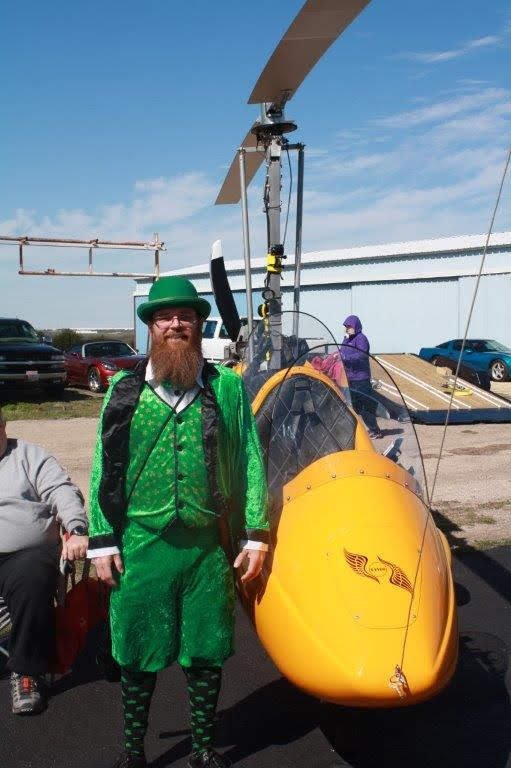
Later in the spring, I flew down to 1.4 hours to (50R-KBEA) Beeville, Texas to visit fellow gyro pilot and friend Ben Cadenbach. Ben and I built our Gyros at the same time. It was a fairly warm day and Ben, who is a pretty big guy gave a ride to another large person. With fuel and all, the Tango carried over a 600 pound payload!

Here is the link to more photos and a video of the trip. Beeville 2019
I also flew all the way around San Antonio in April of 2019 to a Young Eagles event at EAA Chapter 35 from there south to Castroville for fuel and back to Lockhart.
Check out all my cross country flights as recorded on Naviator.
Catching Up
During the past couple of years, I have neglected to post here. In 2018 my wife Danita decided that she wanted to share my experience in Gyroplanes. So, we sold my Air Command Gyroplane and purchased our Tango 2. Here are photo links from 2018:
Photos of my Air Command for sales purposes: 2018 Air Command
Some of the photos were from my trip to Bensen Days in March! The Air Command sold during Barry Days in North Carolina the next month.
I started building the Tango with Alexander Vagner at his shop in Roswell Georgia just prior to the sale of the Air Command. The photos in this folder were used as part of the build log submitted for the Air Worthiness Certificate.
Tango 2 Build Log Photos
FAA Build Log and Documents
Here are photos and videos from the PRA convention in 2018 where we put over 17 hours on the ship as a demo for Tangogyro. 2018 PRA Convention Mentone, IA
This a later trip from Cedartown, GA to Piedmont, AL with fellow Tangogyro pilot and builder Medi from California with our instructor Jon Carleton. 2018 Cross Country
By the end of 2018, I had enough time and experience to study for and pass the FAA Sport Pilot written and practical tests. I took the written test in San Antonio and the practical with DPE Mark Sprigg in Gulf Shores, AL.
I will post 2019 flying activities in a later blog.
Tuesday, July 25, 2017
Saturday, July 1, 2017
Air Command Cross Country Trip to Piedmont-Centre, Alabama
I purchased a video editor and I like the features it offers. I added photos, titles and the music came with the software.
Sunday, June 25, 2017
Pattern Work Videos
Here is another couple of videos from my Air Command flying in the pattern in Cedartown, GA. My friend Rex Garner is in a Red Baby Ace on a right hand base leg in the first video.
Sunday, June 18, 2017
Redundant Fuel Pump
Fellow Peach State Rotorcraft Club member Louis Gulley helped me remove the old pump that transferred fuel from the auxiliary tanks to the main tank and install this new pump on my gyroplane. It establishes a redundant system to the engine. Both fuel pumps feed off all three tanks. The electric pump will be used to prime the carbs then turned off until take off and remain on throughout the flight.


Saturday, June 10, 2017
Flying Angels Relay for Life Breakfast Fly-In
The morning weather today was awesome! Mid 60s on the ground, but, warmer aloft and virtually no wind. I left Cedartown at about 0740 in my Gyroplane while Jon Carleton was testing the new yellow Tango.
I was the first pilot to fly in to the breakfast at around 0800. The food was great and it was for a great cause. By the time I finished eating, Louis Hartsell arrived in the Buzzard Gyroplane. He was about the fourth pilot to arrive. He stopped at the FBO for a restroom break and I was walking down to let him know where the breakfast was being served when Ron Hlozansky arrived in his car. Ron told him where the food was being served and he started up his machine to taxi down, so I rode with Ron back to the KMZ Hanger and the breakfast.
About a 15 minutes later Jon Carleton, Alex Vagner, Kurt Carlson and Rex Garner all arrived from Cedartown. Jon and Alex touched down first in the yellow Tango followed by Kurt in the white single place Tango and then Rex in his red Baby Ace.
I had a lunch date with my wife Danita and was the first pilot to depart the event for the trip back to Cedartown. The trip back to a little longer due to a 5 mph headwind, but, still a very quick trip of about 25 minutes.
I wish I had been able to stick around for the noon lunch event with Ron's gang of sport pilot buddies and get some more afternoon flying, it was such a beautiful day for flying.
Next Saturday, I should have the whole day to hang around, it may be a good day to fly over to Piedmont-Centre, AL and back, just for something to go see and do.
Thursday, June 1, 2017
My First Gyroplane Helmet Cam Video
Tuesday, May 16, 2017
Gyroplanes Love Wind
For local in the pattern flying I now prefer having some wind! Last night I experienced my first flight since January with no wind. I had become rusty at landing with no wind, especially with a dead stick. Nothing major, I just did not like the first two landings with zero throttle. The first one, I came down a bit slow and hard, but, landed in the spot I was planning. On the next landing, I wanted to maintain more airspeed and wound up with a fairly smooth landing, but, not where I wanted to land and wound up way down the runway. On my final approach, I decided to use the throttle to ease the machine down the final few feet with less airspeed than the second approach and hit the spot I was looking for.
Needless to say I need to practice more when the wind is not blowing. I have been spoiled by the winds that have been persistent the past several months. Having a 5-15 mph or more wind in your face, even a quartering crosswind makes taking off and landing much easier. The rotors spin up quickly on take off and the ground speed for both the take off and landing is much slower. Landing requires a little less throttle into the wind and always results in very minimal ground roll.
On cross country trips this summer most days will be with little wind and with a higher density altitude both thrust and rotor performance will be reduced increasing the need for longer take off rolls and more throttle on final down to the runway.
Just a couple of days later I took The Beast out for a quick 15 minute flight. Once again there was no wind, but, the temperature and humidity were both lower thus a much lower density altitude. I also only had 4 gallons of fuel on board compared to the previous flight of 12 gallons. The landings were all much easier to perform requiring less throttle. I also kept the nose down longer as I started to settle through ground effect. The combination of better technique combined with a machine that was performing much better resulted in all three landings being very smooth.
Gyroplanes are affected by density altitude as much and perhaps more than fixed wing aircraft. Gyroplane pilots must keep all the performance factors listed above in mind when taking off and landing, especially on short and or grass fields.
Saturday, May 13, 2017
Future Cross Country Trip in my Air Command Gyroplane
I am planning a 3 day trip to Dickson, Tennessee from Polk County Airport to Dickson County Municipal Airport, M02 to visit the Tennessee PRA Chapter 16 Volunteer State Rotorheads and David McCutchen. Day 1 first leg on a Friday is 60 NM to 8A1, Guntersville Municipal Airport, Alabama, . From there 59.6 NM to Abernathy Field Airport, Pulaski, Tennessee, GZS. The final leg from there to Dickson County is 61.2 NM. Day 2 would be in attendance to the Chapter's Saturday quarterly meeting and day 3 would be the return trip along the same route back to Polk County Airport. My wife Danita Duncan would bring our camper for the weekend.
In order to miss the West Georgia/East Alabama Mountains and the congestion around Huntsville, AL from Polk County would be by heading to Guntersville, AL 8A1 takes pretty much the same route I flew going to Piedmont, slightly north of the range between Cedartown and Alabama. This initial heading is more westerly and is not directly toward Dickson in order to avoid the mountains further to the north. The route would allow a slight deviation further west, if needed for a stop at Centre-Piedmont Airport, Alabama, PYP.
In order to avoid Huntsville, AL the leg from Guntersville, AL, 8A1, would require flying a little more north than needed toward Huntsville Executive Airport, KMDQ for the initial Heading and then back on course to Pulaski, TN, KGZS. Having airport way points that are not planned stops is good practice since they provide gps coordinates and are potential stops if needed.
If I was limited to only 5 gallons of fuel, these would be definite stops with an added stop in Centre-Piedmont, PYP. The trip would take much longer but, could be done with an ultra light.
Another airport way point that I will add between GZS and M02 on the final leg would be Maury County, Tennessee, KMRC.
The route would be as follows as entered into a gps or by using a knee board and compass (data from AirNav):
1st Leg: 4A4 to 8A1 60 NM WNW Initial True Course 293
2nd Leg: 8A1 to KMDQ 30.9 NM NW Initial True Course 332 to KGZS 30.3 NM NW Initial True Course 306
3rd Leg: KGZS to KMRC 24.8 NM N Initial True Course 346 to M02 36.5 NM N Initial True Course 341
Jon Carleton, our Peach State PRA Chapter President, told me about using TCP Lead Removal Additive.sold by Aircraft Spruce for use on cross country trips that would eliminate the need for a crew with mogas. I purchased a bottle yesterday and will test it with Avgas per Jon's recommendation in the pattern before attempting a long trip.
For a long trip I would just need to carry enough oil and this additive for each refueling stop.
Just writing about this is getting me exited about making the trip!

Subscribe to:
Posts (Atom)